
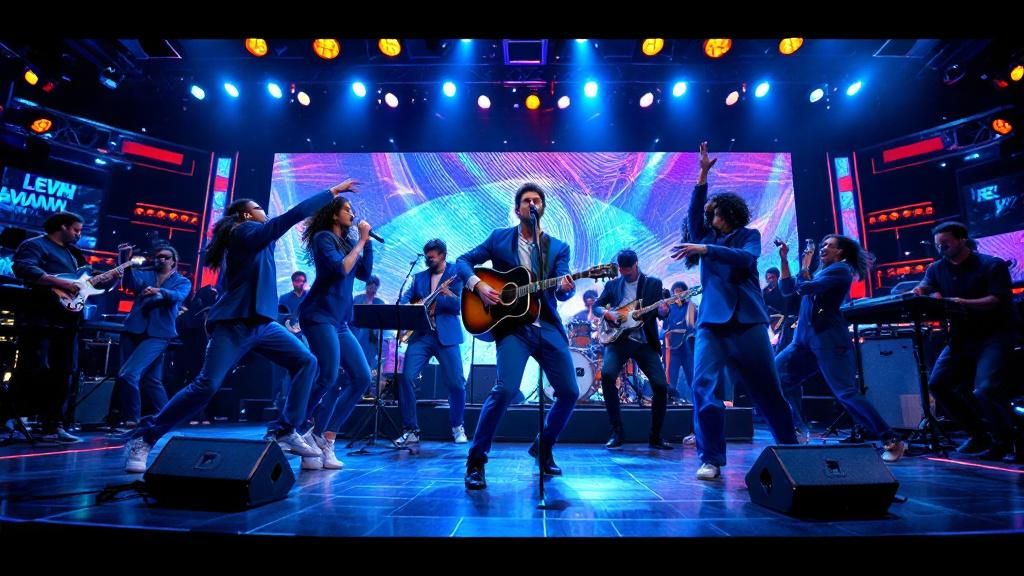
David Byrne brought vibrant theatricality to The Late Show on 31 March, performing a compelling rendition of “When We Are Singing” featuring Stephen Colbert. The Talking Heads frontman, supported by a group of blue-clad musicians and dancers, presented the full choreographic vision that has established itself as his trademark. The track hails from his latest album, Who Is the Sky?, released in September 2025. During his performance, Byrne discussed his deliberate shift towards vibrant, visually engaging presentations and explained his method to integrating solo work with iconic Talking Heads songs on his present tour, such as “Psycho Killer” and “Life During Wartime,” whilst maintaining artistic integrity.
A Dramatic Return to Late Evening TV
Byrne’s feature on The Late Show marked a remarkable demonstration of his developing creative outlook, one that foregrounds visual spectacle and choreographic precision. The performance of “When We Are Singing” illustrated his willingness to engage with songwriting with clever self-consciousness, drawing humour from the unusual facial movements singers invariably display during performance. When exploring his creative decisions with Colbert, Byrne displayed an near-scientific fascination about the mechanics of singing, pointing out how singers’ gaping mouths produce an unclear look that could suggest either intense joy or mere bodily function. This cerebral method to performance art distinguishes his work from conventional pop entertainment.
The aesthetic evolution evident in Byrne’s present tour showcases a deliberate rejection of his former grey staging approach, a deliberate decision rooted in modern cultural demands. He articulated a clear philosophy: the times call for colour, vibrancy, and visual warmth rather than severe austerity. This shift demonstrates Byrne’s awareness of the psychological environment of his audience and his recognition that visual design communicates meaning as effectively as vocal expression or musical composition. By working alongside his costumed performers, Byrne has developed a cohesive visual language that complements his musical exploration whilst conveying an optimistic, forward-looking artistic stance.
- Byrne deliberately selected “When We Are Singing” to highlight the ridiculous nature of facial expressions
- Current tour features vibrant blue costumes substituting for previous grey visual design
- The show includes Talking Heads classics alongside solo material from Who Is the Sky?
- ICE footage woven in deliberately at conclusion of “Life During Wartime” for effect
The Artistic Direction Underpinning Who Is the Sky?
David Byrne’s most recent album, Who Is the Sky?, released in September, constitutes a continuation of his enduring investigation into human behaviour, perception, and artistic expression. The record functions as a artistic fountain for his present touring venture, with “When We Are Singing” exemplifying his ability to draw deep insights from daily instances. Byrne’s approach to songwriting remains markedly cerebral, transforming ordinary observations into powerful musical stories. The album’s thematic concerns—how we portray ourselves, what our expressions reveal or conceal—shape every aspect of his stage shows, creating a unified creative vision that extends beyond conventional album marketing into territory that is more philosophically ambitious.
The creative collaboration between the new material and Byrne’s reimagined concert aesthetic creates a cohesive experience for viewers. Rather than treating Who Is the Sky? as simply another body of work to be performed, Byrne integrates its conceptual framework into the visual and choreographic dimensions of his productions. This holistic approach demonstrates his long-standing dedication to dissolving boundaries between music, dance, and visual art. By selecting specific tracks like “When We Are Singing” for elaborate theatrical treatment, Byrne demonstrates how modern composition can move beyond the recording studio and become fully realised performance art on stage.
Reimagining the Live Music Experience
Throughout his career, Byrne has consistently rejected the idea of fixed, invariable live performances. His approach stresses constant evolution and adaptation, treating each concert run as an occasion to reassess how music should be experienced live. The decision to transition from subdued staging to bold, vivid visual presentation embodies this commitment to reinvention. Rather than depending upon backward-looking sentiment or past achievements, Byrne deliberately develops new visual languages that complement his present creative interests, ensuring that his shows remain timely and powerfully moving rather than simply backward-looking.
Byrne’s partnership with his group of blue-dressed performers represents a intentional commitment to choreographic storytelling. By partnering with skilled artists who grasp both movement and musical vocabularies, he crafts multifaceted shows where movement, costume, and sound communicate simultaneously. This multidisciplinary approach sets apart his shows from conventional concert experiences, framing them instead as immersive creative experiences. The integration of classic Talking Heads material paired with new material shows that reinterpreting need not involve abandoning one’s past—rather, it involves placing earlier work within new artistic contexts that honour their integrity whilst exploring new possibilities.
Reconciling Tradition with Innovation
David Byrne’s approach to his catalogue reveals a refined comprehension of artistic responsibility. Rather than discounting his Talking Heads era or being wholly consumed by it, he has developed a philosophy that allows him to honour the past whilst sustaining creative autonomy. This balance demands careful curation—selecting which classic tracks warrant inclusion in contemporary sets, and how they should be contextualised within new artistic frameworks. Byrne’s openness to staging “Psycho Killer” and “Life During Wartime” alongside solo material illustrates that legacy need not equate to stagnation or cynical nostalgia-chasing.
The challenge Byrne highlights—becoming a “legacy act that performs the old hits”—reflects a genuine artistic challenge that many veteran performers face. By strategically restricting his use of earlier material and regularly rethinking production aesthetics, he preserves creative credibility whilst honouring his past. This approach protects both his creative principles and his listener connection, making certain that concerts serve as vital meaningful performances rather than museum exhibitions. His resistance to committing to a full Talking Heads reunion additionally reinforces his commitment to artistic evolution over commercial convenience.
Talking Heads Work in Current Times
When Byrne presents “Life During Wartime” today, the song holds distinctly present-day resonance. By licensing ICE footage to enhance the track’s close, he reimagines a 1979 post-punk piece into a reflection about current political circumstances. This editorial approach—showing the imagery solely at the conclusion rather than throughout—demonstrates astute editorial discretion. The approach acknowledges the footage’s emotional impact whilst avoiding the performance from becoming overwhelmingly bleak or didactic, maintaining the song’s artistic integrity whilst strengthening its relevance.
This framing methodology goes further than mere visual accompaniment. Byrne’s decision to integrate Talking Heads material into his touring group’s artistic framework establishes creative conversation between past and present. The costumed performers and dynamic production design transform how audiences experience these well-known pieces, discarding retrospective preconceptions and insisting upon conscious involvement with their contemporary meanings. Rather than preserving the songs frozen in time, this approach permits them to evolve in fresh creative settings.
- Strategic inclusion of classic tracks forestalls artistic stagnation and legacy-act status
- Visual recontextualisation enhances contemporary relevance without undermining artistic authenticity
- Rejecting reunion enables Byrne to determine how and when Talking Heads catalogue is presented
The Foundations of Excellence
David Byrne’s method of live presentation extends far beyond simply playing songs—it constitutes a deliberately crafted artistic philosophy grounded in visual narrative and audience psychology. During his performance on The Late Show, he articulated this outlook with characteristic thoughtfulness, outlining how apparently ordinary observations about human behaviour inform his creative choices. His performance of “When We Are Singing” illustrates this perspective: the song stemmed from Byrne’s observation that singers’ open mouths during singing generate an ambiguous expression—one that could imply either profound ecstasy or basic physiological necessity. This wry observation transforms into theatrical content, showing how Byrne draws from daily life for artistic substance.
This philosophical framework applies to his broader approach to tour production and staging. Rather than viewing concerts as unchanging displays of studio recordings, Byrne regards each tour as an opportunity for complete artistic reimagining. His choice to incorporate the present tour with colour—a deliberate contrast to the grey aesthetic of his prior stage designs—demonstrates deeper convictions about art’s social responsibility. In his perspective, modern audiences facing uncertain times require visual dynamism and chromatic richness. This is not simply a stylistic preference; it embodies Byrne’s conviction that performance art has a responsibility to inspire and invigorate, to provide sensory and emotional nourishment beyond just the music.
Colour’s Significance in Modern Times
Byrne’s explicit statement—”the times we live in, we need some color”—demonstrates how he frames artistic decisions within wider cultural landscapes. The shift from grey to vibrant blue-clad dancers and colourful staging underscores his belief that aesthetic choices hold political and emotional weight. This choice recognises current concerns and doubts whilst providing an counterbalance through colour saturation. Rather than withdrawing towards austere monochrome, Byrne argues that art should actively resist despair through its visual language, converting the performance space into a space of deliberate, necessary colour.
